


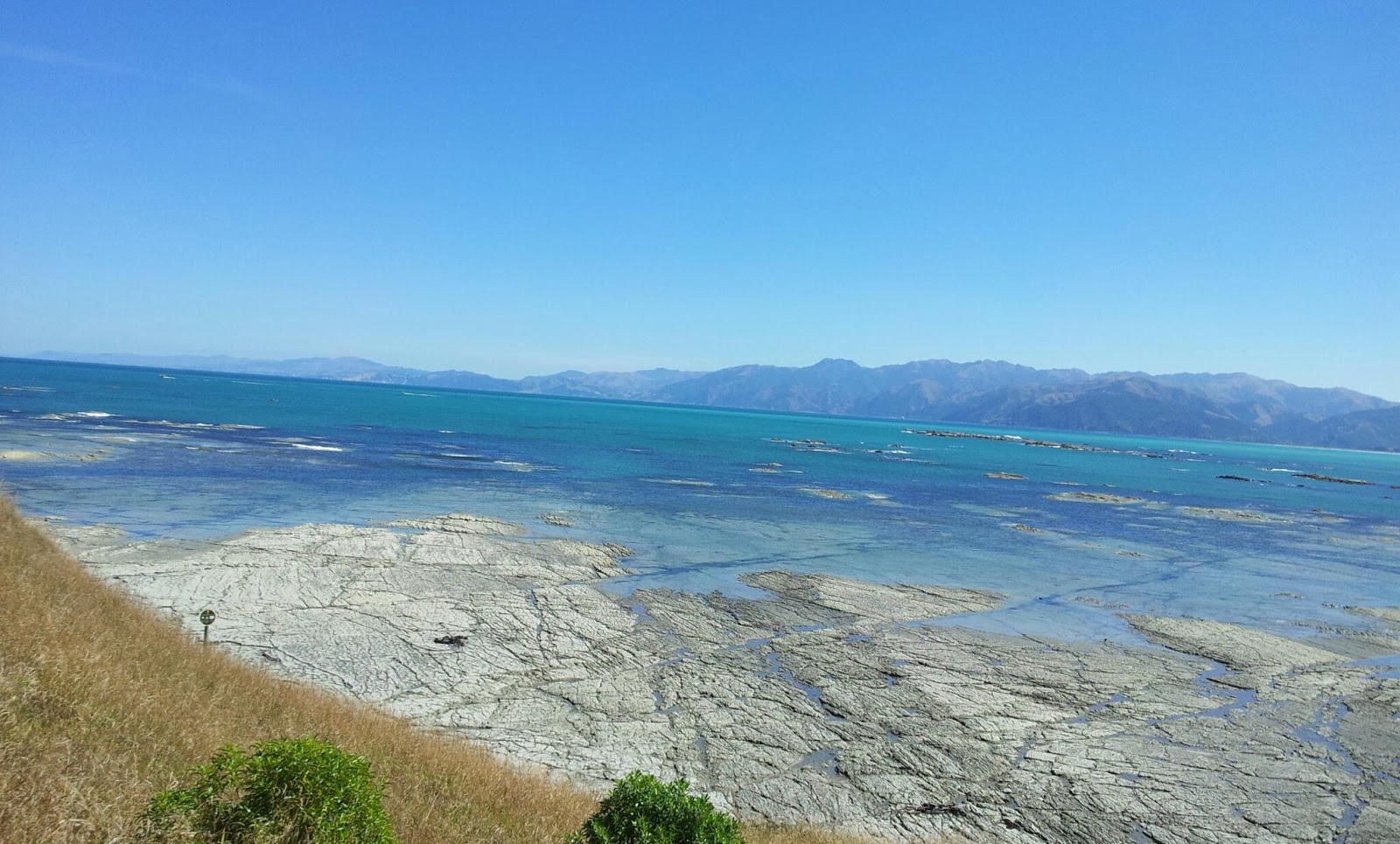
Kaikora
This is our second night here. We left Christchurch yesterday morning in a light drizzle and drove through varying degrees of rain, in some places very heavy. It is so unfortunate as we came through the part of the coast known as the Alpine Pacific. As with Catlins Coast the visibility was not good so we did not see so much of the scenery. Even in the rain and low cloud it was obvious that the Alpine description was apt. The road wound between forested canyons, round and round and up and down. On arrival on Kaikora it was still raining, we looked at a couple of informal beach side campsites but because of the weather decided to go on to the tried and trusted Kiwi, even though we suspected in would be crowded. It is probably the nicest Kiwi site we have stayed on, it,s small and divided into hedged grassy areas. We got a pitch in a very nice place, tucked away in a corner. We spent a comfortable evening in the warm kitchen drinking wine and playing cards.
We woke to a beautiful sunny day and for the first time since Te Anau didn't get straight on the road, we decided to stay here for another night. We had a car reorganisation and tidy and did some washing before going a couple of km down the road to visit The Maori Leap Cave. As limestone caves goes it was not spectacular, but extremely interesting because of it's size and our ability to be so close to everything. We were the only people on the 'tour' and our guide was the guardian of the cave, a gentleman even older than ourselves. It soon became apparent to him that we knew a bit about limestone and flint, the history and the geology, so the 40 minute tour became a discussion and lasted 65 minutes. It was extremely enjoyable.
Back to the campsite for a beer and a spot of lunch, then off on the main event of the day, a walk around the Peninsular. This was excellent, the coast here is beautiful, limestone deposits close to the surface creating a wonder world of nays and inlets, with seals and shear waters and many other birds. We stopped at a roadside BBQ hut for grilled crayfish with rice and salad. We were making our way along the road for the last boring 3 kms to get back to the campsite when a woman on a car called over to ask of we would like a loft into town. We were so grateful, we had just walked 12 kms.
It has been warmer today, I wore shorts, however it is still cool out of the sun. Further north tomorrow, so here's hoping.
The full impact of post earthquake devastation didn't really hit me until I saw it for myself am


Oamaru, North Otago
We left the campsite on the Otago Peninsula this morning. We liked that area and could easily have spent another day there, but the campsite was very cramped. It's understandable as there isn't much flat land to spare, but we could have almost held hands with the people in the van pitched next to us. We thought about moving to another campsite, but that would have been off the Peninsular, the other side of Dunedin. We are also starting to give some thought to how the rest of the time on the South Island might be spent, we would like to get a ferry back to the North Island by the 27th at the latest. We could in fact have travelled much further today, but Oamaru looked like an interesting place. Maybe it's not as interesting as I thought, there are some fine Victorian buildings and a beautiful park, but not much else. The campsite is good though, with plenty of space.
We have booked another trip for this evening, to two Penguin colonies. First to the Yellow eyed Penguin, which is under threat as an endangered species, in fact there is a problem at the moment as many have been found dead at this time when they should be breeding. As far as we know the reason is unknown at the moment, but maybe a viral infection is involved. Then on to a colony of Blue Penguins, the smallest known Penguin. I think that both of these may be unique to New Zealand. Then tomorrow we will head inland and a bit further north, to Lake Tekapo, via the course of the Waitaki River and it's hydro-electricity dams.
I am still surprised at how 'not-warm' it is here. If I equate it to the same latitude in the northern hemisphere, we are close to Cornwall in mid August. We are both wearing fleecy tops. I took mine off for a few moments and only had on a T-shirt over a vest, when the sun came out. As soon as the sun disappeared on went my top again. I haven't worn shorts for over 2 weeks. Nobody seems surprised, they seem to think they are having a good summer here. Maybe it's the almost permanent winds. After the two both trips, to Milford and Doubtful Sounds, my face was horribly wind-burnt. We stood up on the top deck for both trips, even in drizzling rain, making the most of the fantastic views. We are going further inland tomorrow, but also higher, maybe... maybe not....
Christchurch
I suppose the impact of events never really hits you until you se them for yourself. The devastation in Christchurch is indescribable. The series of earthquakes in 2010 and 2011 when 186 people died has left the centre of the city a mass of rubble. I spoke to a Kiwi couple from Christchurch when we were at Alexandra and they told me that the heartache just goes on and on, as almost every week it is decided that it will not be able to save yet another historic building, it is too unsafe to repair and it will have to be demolished. We saw that for ourselves, some building clad in scaffolding and supports, while menacing machinery nibbled away at the destruction of others. However in the very centre a project has been set up called 'Re: Start, it opened yesterday. It was buzzing, lots of small stalls and food kiosks. We decided to eat there and had a very good Gyros from Dimitri's Souvlaki van. We are on a commercial Kiwi site tonight, so hot shower and done some washing.
Lake McGregor, McKenzie Country, in the vicinity of Lake Tekapo
It's nice to be properly camping again. We are on a sort-of campsite on the shores of Lake McGregor. I say sort-of because there is a long-drop toilet here, but not much level ground. As we sleep actually in the car rather than putting a tent up it's a lot more comfortable if we are on level ground.
We saw 4 yellow eyed penguins last night and hundreds of blue penguins. Two of the yellow penguins were chicks on a high ledge in the cliff face, waiting for the parent birds to come a shore and feed them. We saw two adult birds getting out of the water preparing for the hard climb up the cliff face, heavy with their food filled stomachs ready for regurgitation into the mouths of their chicks. The blue penguins came a shore in groups (called rafts) and hurried off to their nesting areas. As we returned to the camp site in the bus we saw stray birds on and beside the road making their way to unlikely nests under old buildings.
Back on the road this morning we turned inland to more glorious mountain scenery. We stopped off a couple of times to wonder at the construction techniques involved in the building of two of the hydro-electric dams across the Waitaki River, at Kurow and at Lake Benmore. The first one at Kurow was the last one to be built without the aid of mechanical equipment, just men, picks and shovels. The enormous dam at Lake Benmore has a 100 metre high earth barrier and water from four different lakes is fed into it.
We continued through Twizel, built originally as a settlement to house the men and their families as they worked on the construction of the dams, now a smallish town which serves the tourist industry associated with Mt Cook. It was a glorious sunny day, but there was a cap of cloud lingering on it's summit, which I think is very usual. Still I got a photo of most of it.
We had decided that Lake Tekapo would be a good place to overnight, but were a bit appalled at the description of the commercial Campsite and there aren't any DoC sites in the area. However the RG mentioned a DoC type site about 10 kms outside Lake Tepako, by a Lake McGregor. We weren't sure we were in the right place as there was no clear information about how to find it, and no sign posting from the road. We had nearly given up when we fell upon it, an idyllic setting on the shore of the lake, but very rough and uneven on quite a slope. There is a long drop and water from the lake. Even here we were surprised and a bit disappointed when a couple of large motor homes turned up, but it's mostly tents and people sleeping in their cars like us.
We sat down by the lake for the afternoon, reading, drinking beer and watching the birds. We saw Crested Grebe, Coots, Black Swans, and a finch-type bird, a bit like a chaffinch, I'll have to look it up.
When we camp in the U.K. and elsewhere in Europe we usually try to avoid caravan sites, if possible seeking out tent only camps or at least ones which segregate the tents from the caravans, and we have encountered very few of these beasts of Motor Homes. There is of course the anecdotal moment when one turned up at Breck Farm, the most unspoilt of all our local campsites. John was heard to say 'whatever is that monstrosity doing here!' Only to learn that ot was friends of tje person standing next to him and coming to join our group. Even in Southern Africa we never felt overwhelmed by Motor Homes, most people tented, quite a few had trailer tents, but they were still tents. It doesn't seem to be just tourists in the Motor Homes here, there are lots of New Zealanders using them too. I can only think it's the inclement weather and the heavy rainfall. The Motor Homes Parks, which is what they are called, are exactly that, often like large Car Parks but with amazing facilities. However it does make camping a very different experience.


